Showing posts with label Westerns. Show all posts

Tuesday, November 19, 2019

Django The Bastard (Italy, 1969)


If you prefer your Italian Westerns dark, as I tend to, the waning years of the sixties is your vintage of choice. It was during that period—roughly all of 1969 through the first half of 1970—that some of the cornerstone films of the gothic western genre were released, among them Antonio Margheritti’s And God Said to Cain, Robert Hossein’s Cemetery without Crosses, and the bastard that I’ll be discussing today, Django The Bastard.

Django The Bastard is one of the only, and perhaps the only, of the Django films that could be considered a direct sequel to Sergio Corbucci’s 1966 original. That’s because, rather than simply slapping the name Django on its protagonist for marketing purposes, it honors Corbucci’s conception of Django by presenting him as a blunt archetype; a specter of vengeance who strikes terror into the hearts of evildoers by merging in and out of the shadows, much like the American pulp anti-hero The Shadow. Of course, here, rather than showing up in town with a coffin dragging behind his horse, he shows up bearing a grave marker on which the name of his intended victim is written. In both cases, he’s a pretty morbid dude, is what I’m saying.


As directed by Sergio Garrone and portrayed by co-writer/star Anthony Steffen (aka Antonio De Teffè), the film’s incarnation of Django could rightly be called two dimensional, but can’t be faulted for lacking flesh and blood. That’s because, by the end of the film, the filmmakers are pretty clearly suggesting that this Django is not flesh and blood at all, but rather a straight up ghost. As such, the traditional way for a villain to greet him is by first shouting “but you’re dead!” before trying and failing to kill him. This interpretation is leant weight by the surfeit of spooky atmosphere that Garrone and cinematographer Gino Santini bring to the task of telling the story.

At the picture's opening, Django arrives in whatever godforsaken burgh this movie takes place in (when not specified, I tend to think of all Spaghetti Westerns as taking place in a fabled every-land much like the Shaw Brothers’ oft-visited Martial World) carrying a cross-shaped grave marker bearing the name Sam Hawkins. Hawkins (Victoriana Gazzara) is one of several turncoat confederate officers who betrayed Djangos army unit and left him for dead. (There is a surreal flashback to this event that lends Django the Bastard a similarity to another supernaturally tinged western, Giulio Questi’s Django Kill!] Now it’s some fifteen years later and Django is looking to track down those officers and subject them to some variably poetic and uniformly violent justice. Fortunately for him, all of them seem to have settled in the same town. Hawkins, in particular, appears to have done very well for himself in the years since screwing over Django and his comrades, and now rules over the town like some kind of personal fiefdom.


At Hawkins' side is his son Jack, an overgrown cretin played by Luciano Rossi, whose bleached mop of hair signals that his part might otherwise have been played by Klaus Kinski. Hawkins has paid Alida (Rada Rassimov) a money-obsessed bar girl to marry Jack and give him grandchildren. The fact that Alida, a cold hearted gold digger if there ever was one, is the movie’s primary female character means that there is little potential for Django to make love connection while on the vengeance trail.

Not that Alida doesn’t try. Indeed, it is Django’s exchanges with her that provide some of the script’s most pithy lines, such as when Alida offers to split Hawkins’ fortune with him. “I’m not interested in money,” Django says grimly. “You can’t buy much with hate,” Alida replies.

On a similar note, Alida tells Django at a later point that, with Hawkins’ money, they will be “rich forever.” “We won’t live forever,” says Django flatly.


And so Django goes about surreptitiously strangling, shooting, garroting and otherwise dispatching his betrayers, along with many of their minions. It gets to the point that the respective gangs have been driven into such a paranoid panic that they begin to war with each other. It is against this chaotic backdrop that Django and Jack hunt each other down, each hoping to kill the other before being killed themselves. Their final confrontation is, of course, violent and, for that added dash of sacrilegious frisson, staged in a darkened church.

I have seen Django The Bastard referred as a “horror Western” and I suppose that works, though I think the film’s reliance on fast-paced action plants it more squarely in the Western genre. Also to be considered is the fact that the film ultimately leaves open the question of whether or not Django really is a supernatural being. In this way, the filmmakers get to capitalize on the story’s spooky elements without sacrificing the credulity of audience members who came to the film expecting a straightforward Western. I don’t think those filmmakers had the ambition—or the stones—to do otherwise. If the film was an equal combination of the genres, it would wreak havoc with audience expectations. The horror aspect of the story would push us to see Django as some kind of monster, and empathize with his victim's suffering, while the Western would encourage us to identify with him as a hero, and revel in the suffering he inflicts upon his victims, who are, after all, the bad guys.


Because that’s the way Westerns work: the lone stranger who arrives in the strange town at the beginning of the picture is usually the one whose viewpoint we take, as his situation mirrors ours as we cautiously trek, guns drawn, into the strange new narrative that awaits us. While Django The Bastard is not the strangest Spaghetti Western that I’ve seen, its genre blending does sets it aside from the more prosaic films of its ilk enough to make it well worth seeing.

Tuesday, December 6, 2016

El Asesino Enmascarado (Mexico, 1962)


Miguel Aceves Mejia began his career as a singer of renowned versatility and grace, earning from his fans the moniker “King of the Falsetto”. In the late 50s, he moved into film, making over 60 films in the ensuing years, many of them westerns. Among these was a series of three films he made for Sotomayor, in which he played the singing lawman Sheriff Miguel. El Asesino Enmascarado was the second of these films, following closely after El Rey de la Pistola and immediately preceding Camino de la Horca, both of which were made during the same year.

El Asesino Enmascarado begins on a jaunty note, with Miguel belting out a robust Ranchero number as he rides his way homeward across the range. This introduction, combined with the fact that Mejia is joined in the cast by a pair of popular songbirds of the day, might lead you to the think that the movie will be a musical, although, aside from a scattering of diegetic songs during the first act, that is not the case.


One of those aforementioned songbirds is Lilia Prado, a beloved singer, dancer, and actor who appeared in over 100 films over the course of her career, including Luis Bunuel’s Wuthering Heights and Illusion Travels by Streetcar. Here she plays Lola, a saloon singer who appears to be intended as Miguel’s love interest. As such, she is none too pleased when a mysterious female card sharp named Luz arrives in town and strikes up a flirtatious rapport with Miguel. Luz is played by Ana Bertha Lepe, another beloved Mexican entertainer who also played one of the man crazy Venusian ladies in La Nave de los Monstruous. Lepe sings a lot in her movies (the lucha also-ran El Asesino Invisible, in which she played herself, was little more than a showcase for her talents), so it’s a little surprising that she doesn’t sing here. She does, however, prove herself handy with a whip in one of the film’s early fight scenes.

Luz spends her days emptying the townsfolks’ pockets at the poker table and attracting unwholesome stares from her fellow bar patrons. When she is not doing this, she shares an upstairs room in the saloon with a mysterious, black garbed man whose face we never see (though, if we did, we’d know that he was played by Joaquin Cordero.) Could he be the masked killer who has suddenly started picking off townspeople left and right? Probably, but we must first wait for Sheriff Miguel and his partner Ramon (Luis Aragon) to do a lot of nocturnal snooping and fist fighting before we can find out for sure.

El Asesino Enmascarado is exactly the kind of cheap and efficient B film that the Mexican film industry reliably churned out in great numbers during the 50s and 60s. In a lot of ways, it feels like a TV western, with most of the action confined to either the saloon set or a limited number of outdoor locations. Director Manuel Munoz and cinematographer Fernando Colin compensate for this by setting a lot of the film’s action at night and utilizing a noirish play of light and shadow in their compositions. Munoz also keeps things commendably fast paced, cramming a lot of plot and—often surprisingly violent--action into a brisk 90 minutes.


To be honest, El Asesino Enmascarado is not a film I would have sought out if not for the fact that it was the second film on a double feature disc that also contains El Charro de las Calaveras, a supernatural western in which a woman carries around what appears to be the head of “Black and White” era Michael Jackson in a box. That’s some pretty formidable company for a film as straightforward and inoffensive as El Asesino Enmascarado. Though I would recommend it to any Spanish speaking fan of B grade westerns, who I think would find it pretty satisfying—especially if enjoyed con muchas cervezas.

Monday, April 4, 2016

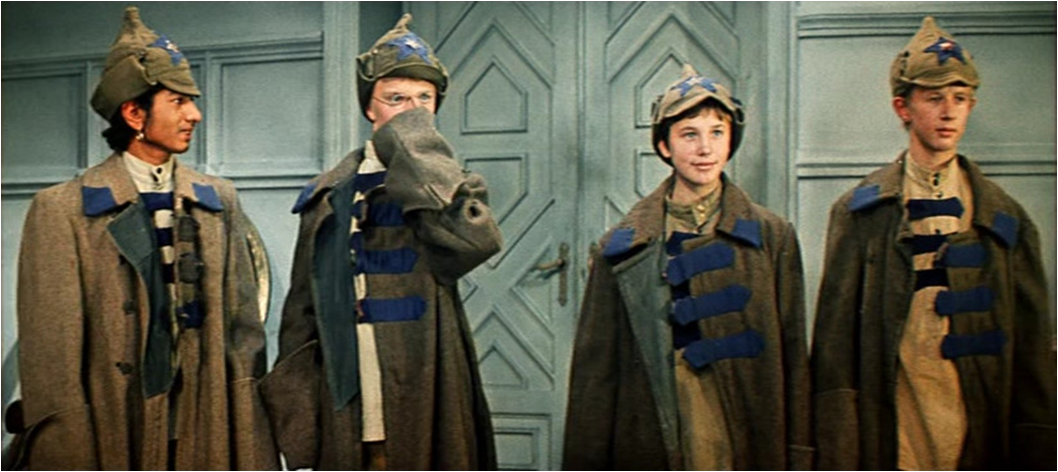
The Elusive Avengers, aka Neulovimye Mstiteli (USSR, 1967)


While many film enthusiasts would be content, upon seeing a passing reference to a genre of Soviet westerns made during the height of the Cold War, to think "huh, interesting" and then move on with their lives, I am the guy who has to immediately find and watch one of those movies. Of course, given the cornucopia of obscure foreign films that YouTube has become in recent years, this is a far less laborious task than it once was--which is why I'm hanging upside down in a gimp costume as I write the. You gotta suffer, people.

Loosely based on Little Red Devils, a novel by Pavel Blyakhin, The Elusive Avengers spawned two sequels, making it one of the more popular examples of the uniquely Russian riff on the Western genre known as the Ostern, or “Eastern.” Like most Osterns, it is set in Ukraine during the chaotic period of civil war that followed the Russian Revolution. This conflict saw a variety of anti-Bolshevik factions take arms against the Lenin regime, making uneasy provisional allies of everything from monarchists to capitalists to more democratically-minded socialists. Despite this smorgasbord of potential alliances, it should come as little surprise that the actions of the film’s titular heroes, while motivated by vengeance, are entirely in keeping with the interests of the Red Army.


In the film’s opening, Danka, a young village boy, watches in horror as his father, a spy for the Russian government, is summarily executed by the vicious warlord Lyuti (played with dissolute menace by Vladimir Treshchalov.) We immediately skip forward a few years to find that Danka and three of his teenage friends have since banded together to defend their home against the gangs of bandits, rebels, and rogue Cossacks that are preying upon the peasantry. In addition to Danka (who is now played by 16 year old Viktor Kosykh), we have Yashka, a gypsy (Vasily Vasilev), Valerka, an intense student-type (Mikhail Metyolkin, in Trotsky-like glasses to drive the point home), and Danka’s sister, Ksanka, a nun (Valentina Kurdyukova.)

At first the group focuses their efforts on the bandit gang led by Ataman Burmash (Yefim Kopelyan), interfering with the transport of his supplies and ill-gotten gains in a series of exciting horseback raids. When it later becomes clear that Burmash is taking orders from Lyuti, the offensive takes on a more personal—and violent—cast. The result is a series of increasingly risky, late night guerilla operations in which the young Avengers, true to their name, elude capture only by the skin of their teeth.


It is worth noting that The Elusive Avengers, in making nods to the Western genre, takes little influence from the American Westerns of Ford and Hawks, and rather more influence from the then-contemporary Euro-Westerns of Leone and Corbucci. This circumstance, as unsurprising as it is, is a happy one, as it means that we get lots of dramatic widescreen composition and sweeping vistas, moody nighttime action, and an expert ramping up of tension. Director Edmond Keosayan layers onto this an element of “Boys’ Own” adventure, building up excitement as we watch our teenage heroes pull off one daring caper after another. You almost expect the action to stop so they can give a thumb up to the camera and tell all the kids out there how “awesome” it is to fight the enemies of communism (there is indeed a fourth-wall-breaking wink at one point. )

The Elusive Avengers is served well by its energetic young cast, among whom I think Vasily Vasilev, who in the same year played a small part in Tarkovsky’s Andrei Rublev, is the standout. As Yashka, the group’s token “ethnic” (a Chinese in the book, an American black man in an earlier film version), he is not positioned as the film’s lead, but nonetheless steals that position by virtue of his sheer charisma and physicality. With Danka providing the vengeful fire that motivates the group, and the studious Valerka planning all of its operations, Yashka is the warrior of the group, left to be at the center of all of the film’s most exciting action set pieces. Among these is a scene depicting the Avengers’ defense of a military cargo train from a gang of bandits on horseback that is so similar to the iconic train sequence in Sholay that it is hard not to imagine it being an influence.


And this is all not to mention Vasilev’s singing and dancing, which are displayed in a scene that takes place after Yashka and Ksanka take jobs as entertainers at a tavern frequented by Burmash’s gang. Indeed, The Elusive Avengers is also something of a musical, with several diegetic scenes of characters breaking into song. This adds considerably to the picaresque sense of fun that intermingles intriguingly with the dark Spaghetti Western dynamic seen elsewhere in the film. Of course, I watched an untranslated version of this movie, so, if they were singing about burning the fat American capitalists in their beds, I might view it otherwise. I doubt that’s the case, though; Given the film seems largely directed at those young men most likely to be seduced by its romanticized depiction of Russian youth defending the homeland, I don’t think it would resort to such buzz-killing cold war proselytizing.

That is, until the end, when the Avengers receive an audience with Joseph Stalin himself, who thanks them for their exploits and makes them members of the Red Army on the spot. I assume this means that, in the film’s sequels (The New Adventures of the Elusive Avengers, in 1968, and The Crown of the Russian Empire/Once Again the Elusive Avengers, in 1971), the kids fight as soldiers of the Russian military, rather than as a ragtag band of teenage rebels. If that’s the case, it’s hard to imagine those sequels being as fun or exciting as The Elusive Avengers--although I do intend to find out.

Tuesday, May 6, 2014

Las Tres Magnificas (Mexico, 1970)


Thanks in large part to the Italians, the rules of the movie western were as loose as they would ever be during the late 60s and 70s. So why not a film like Las Tres Magnificas, in which a beleaguered frontier town finds salvation in the form of a trio of pantless chorus girls turned vigilantes? Of course, such burlesque set ups were typical of the good naturedly horny Mexican pop cinema of the era, especially when an eye popping "usual suspect" like the beautiful B movie starlet Maura Monti was involved.

Las Tres Magnificas was Monti’s second to last feature film -- the last being 1971’s The Incredible Invasion with Boris Karloff -- and followed right on the heels of the wonderful Cazadores de Espias. Some of Monti’s co-stars from Cazadores are also here, including Eleazar “Chelelo” Garcia, who, true to the Mexican pop cinema rule of quotation marks, is known mostly for his comedic turns. The fact that Garcia’s character is the closest thing that Las Tres Magnificas has to a villain speaks adroitly to the film’s lightweight nature.


Here Garcia plays bumbling bandit Felipe Mendoza, who, along with his two gun slinging sons -- Clemente, who dresses all in white, and Modesto, who dresses all in black -- poses an ongoing nuisance to the people of Las Tres Magnificas’ subject town. It should be noted that, while both sons are portrayed as every bit as oafish as their dad, they are in fact played by a pair of bona fide Mexican matinee idols; Latigo himself, Juan Miranda, in the instance of Clemente and Dominican sex symbol Andres Garcia in that of Modesto. In any case, seeing as this particular town comes with the usual combination of timid sheriff and passive -- indeed almost invisible but for the habitués of the saloon -- populace, the local padre has no choice but to seek help from outside.

This he finds in the much touted form of the titular Magnificas, whom he comes across in all their frilly knickered glory during one of their beer hall song and dance numbers. In contrast to Monti, who plays Candida, the remaining Magnificas are played by a pair of actresses who might be less familiar to Mexican genre movie fans. Where we might expect to see, say, Lorena Velazquez or Amedee Chabot, we instead have famous ranchera singer and actress Lucha Villa as Paz and former pageant winner and future soft pop singer Renata Seydel as the blonde Dulce. From this point on, much comedic hay is made of the irony of this bawdy trio taking their marching orders from a man of the cloth, with the Magnificas at one point even masquerading cheekily as choirgirls.


Because of its cast and concept, I had hopes that Las Tres Magnificas would be sort of a western version of one of the Las Tigressas movies. That hope, however, was in vain. More of a comedy than an action film, Magnificas, rather than endowing its heroines with Emma Peel-like martial skills, focuses instead on the havoc they cause just by being women. As such, the pastor has them hit the town disguised as a trio of virginal belles of the prairie, their garters and frilly intimates amply concealed beneath layers of bustles and petticoats. From there they proceed to seduce and then systematically humiliate the three Mendozas, leading to jealous squabbling among the gang that conveniently undermines their capacity to commit further crimes.

This is not to say, of course, that Magnificas, being, after all, a western, is completely bereft of action. In one scene, the Magnificas fend off attacking Indians with a cannon mounted in their stagecoach, a pulpy touch that reminded me of the Spaghetti Western’s vision of a frontier littered with abandoned military armaments just there for the taking by any Django or Sartana who happens by. In another scene, the girls masquerade (they do a lot of masquerading) as Indians to attack the Mendozas with bows and arrows. Unfortunately, true to the film’s slapstick nature, this scene includes a bit where an arrow, missing its target, ends up striking a painting of a cow. When that arrow, lodged in the cow’s udder, is pulled out, a stream of milk issues from the painting. Oh my sides!


Given it has at its disposal the highly regarded singing talents of Lucha Villa, Las Tres Magnificas is also something of a musical, with the star being given ample opportunities to belt out throaty ranchera numbers. Even Juan Miranda is given the chance to pluck out a romantic ballad and, later on, joins with the two Garcias in a comic moonlight serenade of the three female stars, who reward them by dumping multiple buckets of water on their heads. All of these melodic interludes, composed by award winning music director Manuel Esperon (a contributor to the score for Disney’s The Three Cabelleros, among others) are pleasant enough, with by far the most catchy being the Tres Magnificas’ theme song, which the stars sing both upon their entrance and departure from the film.

Taken as a whole, Las Tres Magnificas is a pretty pure example of “kitchen sink” 1960s/70s Mexican pop cinema, featuring as it does a bit of comedy, a bit of action, some song and dance, some beefcake and, for Dad, frequent occasion for the Magnificas to be seen lounging about in their complicated preindustrial underwear. And it is at this point in the review that I would normally say something like, “and that’s good enough for me” (accompanied, you might imagine, by the sound of me expectorating and the ring of a spittoon), but the fact is that I could have just as easily taken a pass on this one. Shocking, I know, but, while it has its charms, I see this as one more suited to the completists among you. Of course, that also depends on what you are completing; if it is your viewing of every film starring Maura Monti, then you are indeed engaged in one of life’s most admirable pursuits. If it is the viewing of every film in which a comical barroom brawl is accompanied by cartoon sound effects, then hell is too good for you.

[Note that the version of Las Tres Magnificas I watched lacked English subtitles, which, given the simplicity of the film’s story, caused me little regret other than that I was unable to determine whether it passed the Bechdel Test.]

Wednesday, March 12, 2014

Revolver Rani (India, 1971)


Only the most enfeebled among you will be surprised to learn that contemporary relevance has nothing to do with why I choose to review a film on 4DK. Nonetheless, it is always interesting when some far flung obscurity that I’ve set my sights on turns out to have some. In the case of the 1971 Telegu actioner Revolver Rani, that relevance comes from the fact that current Bollywood “it” girl Kangana Ranaut has chosen to star in a satirical remake of it as her follow up to this year's widely praised Queen.

Those who are familiar with Telegu action films of Revolver Rani’s particular bent -- we’ll call them “vengeful cowgirl” movies -- know that they are ripe for satire. Yet satire, at its best, needs a target that is earnest in intent, and Revolver Rani leaves a lot of doubt as to just how seriously it takes itself. For instance, there is its title sequence, a riot of proto-South Park cut out animation that sees a rapidly spinning Vijaya Lalitha picking off baddies like tin ducks in a carnival shooting range. It’s funny, but also captures perfectly the feel of these movies: antic, breathlessly hyperbolic, and more than a little spastic.


And speaking of Vijaya Lalitha, a warning: those of you who, like me, come to Revolver Rani hoping to see a showcase for that diminutive South Indian dynamo might at first feel like they’ve been the victim of a bait and switch. This is due to the unwritten rule (I’m assuming it’s unwritten, though perhaps it was inscribed on a banner above the studio gates) that Superstar Krishna and his hair had to appear in every Telegu film made. Krishna, I’m happy to say, only dominates the first half hour of Revolver Rani and then, I’m even happier to say, is killed -- though, unfortunately, along with his dog, Peter, who showed a lot of promise as an anipal. This all occurs in the course of Krishna defending his sister, Lalitha’s Rani, from a rape attempt by the band of trigger happy grotesques he has fallen in with. Afterward, Rani -- thanks to Vijaya Lalitha’s unique features and command thereof -- adopts the look of a rabid Keane painting and swears her blood revenge, at which point Revolver Rani becomes the kind of movie we like.

These hoodlums against whom Rani is now pitted, I want to point out, are led by a sharply dressed Mr. Big named Vikram, who suffers from a heart condition that causes him to erupt into violent coughing fits whenever he gets too worked up. As a signature disability for a villain to have, this falls somewhere below a hook hand or eye patch in terms of desirability, as it simply leaves the audience anticipating him conveniently dropping dead during a pivotal moment in the narrative (I’ll never tell).


Adding a nice Magnificent Seven aspect to the typical “ride, rumble, shoot, then dance frenetically” structure of these films, Lalitha’s Rani decides that, to combat the gang, she must first form one of her own, and so rides off in search of suitable candidates. This she does to the accompaniment of the theme tune that music director Satyam has conjured up for her, which consists of basso male voices chanting the English word “vengeance” over a Morricone-esque backing. (By the way, Rani and her crew stay true to their rough riding cowpoke ways despite this film being set in the present day; there are cars and everything.) Rani first recruits a towering strongman for her cause, and then a carnival knife thrower. The vetting process basically involves Rani seeing the amount of grace with which they accept her beating the shit out of them. There’s a street boxer who doesn’t make the cut, but his high strung manager ends up tagging along for comic relief purposes. I think this is same actor to whom I referred in my review of James Bond 777 as “Tollywood’s answer to Jagdeep”.

While there are many familiar faces both in front of and behind the camera in Revolver Rani (many of whom I sadly can’t put names to) one of them is definitely not director KSR Doss, the man behind so many of the Telegu films I’ve covered. Instead a character by the name of KVS Kutumba Rao is in the director’s chair, which affords me the opportunity to momentarily break from my Doss fixation and get some sense of which of the vengeful cowgirl movies’ quirks were specific to the genre, perhaps based on audience expectations, and were not a symptom of one director’s particular madness – to establish a base line for 1970s Telegu action cinema, so to speak.


And the fact is there is little to distinguish Revolver Rani from one of Doss’ films in terms of pacing (frantic) or violence (also frantic -- and cartoonish), though the camera work does not quite approach Doss’ level of insane restlessness. There are also not quite so many of the upskirt shots that Doss was so fond of, though the one that I caught is pretty in your face. And by that I mean right up in there.


Vijaya Lalitha executed a flying scissor hold on my heart from the time I first saw her, in 1972’s Kaun Saccha Kaun Jhoota, back in 2009, and there is nothing in Revolver Rani that could chill my affections. Here the actress again exhibits that same peculiar combination of flitting, bird like movements and bug eyed intensity that, paired with the unrestrained mania of her fighting style – whether with whip, karate, or freestyle wrestling – makes her a signal figure in world action cinema. The only loss here is that we get to see little of Lalitha’s equally frenetic dancing, beyond a scene where she executes the old “infiltrate the villain’s hideout by posing as a nautch girl” gambit. The item girl duties are instead taken over admirably by the actress (Kavitha, perhaps?) who portrays Krishna’s nautch girl girlfriend, Lilly.


And then, of course, because no Telegu movie would be the same without her, Jyothi Laxmi shows up at the last minute for a number in which she demonstrates that sexy dancing and making really ugly faces are not mutually exclusive.


Once gathered, Rani and her gang go about the business of picking off Vikram’s rapey minions one by one while interfering with their various criminal enterprises (a diamond robbery in one case, sex trafficking in another). They then ship each minion’s corpse to their boss in a crate, complete with a nasty note. And, in case you were wondering, Rani does refer to herself as “Revolver Rani”. This activity attracts the attention of both Vikram and the Police Commissioner, who does nothing but listen to the latest tale of Rani’s exploits before staring dreamily off into the middle distance and repeating her name. All comes to a head in a showdown at Vikram’s lair that climaxes with Vijaya Lalitha wrestling a lion. And, yes, that is pretty fucking awesome.

Had I known those five years ago when I watched Kaun Saccha Kaun Jhoota that there would turn out to be many, many movies like it, all of them starring Vijaya Lalitha and/or Jyothi Laxmi, I would have thought my life had become some kind of strange and wonderful dream. And still today, a film like Revolver Rani sends me into an intoxicating reverie, a world very much like that film’s credit sequence, where a pixie-ish firebrand with Sailor Moon eyes spins like a dervish while sending greasily pompadoured, mustached men flying toward every point on the horizon, guns blazing and limbs a blur. True, the inclusion of two musclebound male sidekicks takes the action spotlight off of Vijaya Lalitha a little bit, but the fact that she fights alongside them as an equal (though they rescue her on occasion, she in turn rescues them) makes me respect her even more, and Telegu cinema as a whole for walking the walk.


Now the question: Will I see the remake? The trailer for the film, predictably, shows us a Rani who’s much more dependent upon hardware and fire power than Lalitha’s version. Tell me that Kangana Ranaut wrestles a lion and we might be able to do business.