Monday, January 16, 2012

Guru (India, 1980)


By all rights, I should have looked away from Guru, but lord help me I could not. At the very least I should have stopped listening to it. The version of this Tamil language film that I watched had been subjected to the worst Hindi dubbing job imaginable -- not only on its dialog, but its songs as well. And rather than re-recording those songs from scratch, the dubbers simply pasted the caterwauling Hindi vocals (Asha Bhosle being obviously outside the price range) over the original musical tracks, substituting, for the duration of the sung portions only, a sort of drum machine and Casio-on-factory-settings karaoke approximation of their more lush, live orchestration. It was not good.

At the same time, Guru offers a lot of the searingly colorful grotesquerie and carnivalesque thrill-jockeying that I’ve come to hope for in action films from India’s regional cinema. And this despite the film actually being a pretty close remake of Jugnu, Dharmendra’s solidly middling Hindi thriller from 1973. It even borrows the same footage from the James Bond film You Only Live Twice, as well as some footage from Jugnu itself. More importantly, we get an appearance by what is probably Jugnu’s most thrilling feature, the Jugnu-Mobile, although here it is the Guru-Mobile, thanks to the fact that Guru is, in this version, the name of the altruistic bandit played by our leading man, Tamil superstar Kamal Hassan.


But alongside these familiar elements, Guru makes an effort to establish itself as its own odd breed of beast. In addition to Kamal Hassan’s courageous thief with a conscience, we’re also presented with a pink-clad superhero -- seemingly also named Guru, although obviously played by a different actor -- who strikes terror into the hearts of evildoers through flamboyant and impractical displays of gymnastics (which, as in Gymkata, are entirely dependent upon those evildoers’ surroundings being equipped with the appropriate equipment, such as parallel bars). This Super Guru announces himself via the hurling of a small metal statue of what appears to be a pigeon covered with flashing colored lights -- a practice that I imagine would quickly become prohibitively expensive, kind of like giving everyone you meet a Kindle.


Sadly, once introduced, this magnificent creature is never to be seen again. But Guru has plenty of other gaudy and baffling visual stimuli in store for us -- some of them courtesy of its Hindi inspiration and some all of its own fevered machinations. Mirroring Jugnu, the monolithically pompadoured “Boss” wears on his arm something that looks like an oversized cocktail shaker, and which extrudes all manner of deadly pointy things on command. On the romance front, Sridevi essays the role played by Hema Malini in the original, and when Kamal Hassan first lays eyes upon her, it is in a picnic setting where she is amusing a group of female friends by blasting the words “I love you” into a giant paper heart with a revolver. Do I want to know what this means? Probably not. Nor do I need any further explication of the scene in which Kamal Hassan and Sridevi antagonistically serenade one another while she flies a helicopter and he buzzes her in a light plane.

The cycle of reciprocal remaking between Bollywood and its regional counterparts was and remains a not uncommon practice, with Telegu and Tamil hits frequently being remade for the Hindi market and Hindi films also getting the regional treatment. Then, apparently, those Tamil and Telegu remakes have sometimes been dubbed so that Hindi audiences could enjoy cheaper, idiosyncratic regional interpretations of films they’d already seen in their own language, though this time with all of the music and dialog ruined. Truly, in the condition I watched it, Guru was just one pink superhero away from being completely unwatchable, but sometimes it’s the pink superheroes that make all the difference.


And also the tasteful set decor.

[NOTE: YouTube has some clips of the original musical sequences from Guru, which demonstrate that the songs, composed by Kamal Hassan  favorite Ilayaraja, are actually quite nice in their unmolested form.]

Thursday, January 12, 2012

Friday's best pop song ever

Tonight! The Drive-In Mob with two heads!

One can never have too much head, so tonight’s Drive-in Mob gives you a little something extra. In the first half of our double-domed double-feature, The Incredible Two Headed Transplant, star Casey Kasem counts down the number of noggins on the titular abomination -- and in the second feature, The Thing With Two Heads (aka the movie that ended racism in America!), Free to be... You and Me star Rosy Greer finds himself sharing a body with a crabby old man played by Ray Milland. (You’d probably be crabby too if you had an inescapable second head singing “It’s Alright to Cry” at you 24/7.)

Now, I may be tardy for the first feature, but, believe me, I would give my left brain to make sure that I’m there for the tail end of this, um, double header. DO YOU SEE WHAT I DID THERE? This is the level of wit you can expect tonight, people. I don’t know why you wouldn’t want to tweet-or-at-least-follow along!

And as usual, you can do so by streaming both features on Netflix Instant, starting with The Incredible Two Headed Transplant at 8pm sharp EST, and joining in on Twitter using the #DriveInMob hashtag. Be sure to check the official Drive-In Mob site for full details.

Monday, January 9, 2012

Cinderella and Her Little Angels (Hong Kong, 1959)


Confronted with a film like Cinderella and Her Little Angels, one has cause to wonder just how many of life’s cruelest unpleasantries could be smoothed over by the warmly familiar conventions of the romantic musical comedy. Parodies like The Producers and Cannibal! The Musical, after all, not only mine the absurdity of setting real life atrocities to a jaunty musical score, but also highlight that form’s ability to defang and co-opt such horrors. Thus it’s not unthinkable that such a production could get our toes tapping to the sadly commonplace yet no less grim spectacle of child labor and sweatshop peonage.

A slick product of Hong Kong’s Cathay studio, Cinderella and Her Little Angels tells the story of Xiaolin (Umetsugu Inoue favorite Peter Chen Ho), a shy tailor employed by a swanky Hong Kong clothing shop. Xiaolin is smitten with Danning, a girl from the local orphanage, but has yet to work up the nerve to make his move. Fortunately, the shop has a mannequin that bears an uncanny resemblance to Danning on which he can practice, which isn’t creepy at all.


And why would Xiaolin be familiar with a girl from the local orphanage, you may ask? Well, that, apparently, is where all of the shops garments are made, with Danning basically serving as a cheerfully trilling galley master, urging her fellow orphans –- hunched to the task of sewing away with fingers both tiny and teenaged -- ever forward in their arduous labors through the power of uplifting song. A sample lyric:

You are sewing and I am packing
If you aren’t quick, you can’t get things done
Don’t look around, hurry up, hurry up
Even with no sleep we must try our very best

Danning is played by Linda Lin Dai, a versatile actress whose fame at the time enabled her to work as a free agent for both of Hong Kong’s titans of Mandarin language cinema, Cathay and Shaw Brothers. In 1961 she would sign a contract with Shaw, entering a period in which she would break the record for most awards for Best Actress received at the Asian Pacific Film Festival. Sadly, her suicide in 1964, at the young age of 29, would cement her legendary status, initiating a period of public mourning that saw her funeral inundated by thousands of fans.

And, indeed, Lin Dai’s beauty and charm are hard to miss in Cinderella and Her Little Angels, making it no surprise when Xiaolin’s boss, upon setting eyes on Danning during one of her rare visits to the shop, beseeches Xiaolin to recruit her as a model for his upcoming fashion show. This is a decadent proposition for the modest Danning, but wary of the underfunded orphanage’s desperate need for renovation, she relents, hoping to cover the costs with her modeling swag. Less easy to convince is the orphanage’s conservative headmistress, Madame Kong (Wang Lai), who ultimately must be kept in the dark about Danning’s moonlighting by means of a variety of comedic ruses, most of which somewhat preposterously involve Danning’s aforementioned mannequin lookalike.


Danning, needless to say, proves to be a natural as a model. And the fashion show, accompanied by sung narration from and off-screen chorus, is the clear centerpiece and highlight of Cinderella and Her Little Angels. The salt of Hong Kong, as presented in the film, are not too receptive to the distinctly Western peculiarities of modern fashion, as exemplified by Madame Kong, who calls the “Brigitte Bardot” style sample gown that Xiaolin brings to her “weird”, refusing to have her charges participate in its manufacture. Thus the fashion show sequence seems manifestly intended as a primer for the film’s audience, and as such bears all the hallmarks of a society in the throes of transition, with all of the deep ambivalence that that entails.


This last, I assume, explains why the otherwise chirpy ditties delivered by those unseen singers contain some couplets that seem both perversely and hilariously judgmental. Of a kimono it is said, “Westerners are naughty. They treat it as nightgown.” And, as for another stylish -- and relatively conservative -- evening ensemble:

Look at this new coat
It’s exciting with chest and arms exposed
Modern people like to be sexy
They love to expose their body

Composed by Yao Min, Cinderella and Her Little Angels’ songs, though delivering some harsh medicine, are relentlessly upbeat in tone. And dammit if, along with the winsome performances by the film’s leads, they don’t contribute to it being one of the most charming musicals about cheerful orphans conscripted into forced labor that I’ve ever seen. Toward the end, the singing becomes virtually wall to wall, with the songs providing an ongoing narration describing things that we’re already clearly seeing take place on screen. And if you had any doubt about how things ultimately turn out:

Thursday, January 5, 2012

Friday's best pop song ever

The Infernal Brains Podcast, Episode 9


A thorough knowledge of lucha libre cinema is what separates the Mexi-cans from the Mexi-can'ts. Of course, Tars Tarkas and I are neither of those, but we still try to do our best in this discussion of The Mummies of Guanajuato, a classic of the genre that features all three of its biggest stars: Santo, Blue Demon and Mil Mascaras. As usual, you can download the podcast here, or stream it below while looking at pretty pitchers.

Wednesday, January 4, 2012

Mysterious Island, aka Tainstvenny Ostrov (USSR, 1941)


Jules Verne’s Mysterious Island has been adapted for the screen many times, but seldom, it seems, with much faithfulness. This may in part be due to the makers of those adaptations wanting to insert into them the science fiction elements that are largely missing from Verne’s original. Verne is, after all, inseparable from his reputation as a science fiction author, yet those who tackle this particular example of his work might be surprised by the extent to which it plays as a straightforward adventure. In response to that, the 1961 film version of Mysterious Island famously sought to spice things up with the addition of some Ray Harryhausen begotten giant animals, while the semi-silent 1929 version included a mysterious underwater race and the 1951 Columbia serial added invaders from Mercury.

Thus it could just be that the 1941 Russian film version, Tainstvenny Ostrov, might be the most faithful adaptation of Mysterious Island out there. Though to just what extent it is I personally can’t say for sure, because, as is so often the case, my copy lacks the subtitles that would enable me to determine whether the characters in the film are spouting dialogue in keeping with Verne’s own or simply parroting Stalinist bromides about collective farming. Still, the evidence of the eye is that Tainstvenny Ostrov follows the events of its source material with a surprising level of scrupulousness.

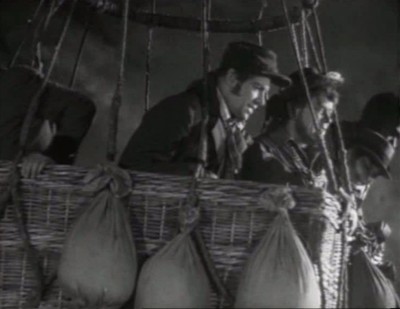
In keeping with that, the film begins as does the book: In Virginia circa 1865. As the Battle of Richmond rages around them, a group of men lead by the northern officer Smith (Alexei Krasnopolsky) make their escape from a military prison in a hot air balloon. Carried away by a storm, they crash land on the titular land mass, which they later dub Lincoln Island. As time goes on, they master the island’s environment, constructing a palatial shelter inside a cliff face, forging tools, creating an irrigation system, and building a compound complete with windmills, farmland and a working elevator.


Throughout this, the group -- which also includes the freed slave Neb (R. Ross), the sailor Pencroft (though it sounds like they’ve changed his name here to “Petrov”), the young boy Herbert (Yuri Grammatikati) and a dog, to name a few -- face a catalog of what could be considered pretty boilerplate island perils: Their camp is invaded by wild apes; another castaway (I. Koslov), who has been reduced to a caveman-like state of savagery, makes the scene; and they are forced to fend off an attack by marauding pirates. All the while they find themselves repeatedly aided by the efforts of a mysterious, unseen benefactor.

As we saw with the recently reviewed Kosmicheskiy Reys, the Soviet film industry had, as recently as the mid 1930s, yet to completely kick off the trappings to the silent era. And, despite its spoken dialog, Tainstvenny Ostrov still shows some signs of the same -- largely due to the frequent use of under-cranked camera work and the heavy reliance on written title cards to move the narrative forward. Aside from this, though, the film is well executed and obviously generously funded. The opening battle scene is far more spectacular than the narrative demands and, once we’re on the island, good use is made of the dramatic natural locations, as well as some impressive matte and miniature work. Co-directors B.M. Chelintsev and Eduard Pentslin also keep the pacing such that, despite the many scenes of the castaways discussing plans by the campfire –- and, in my case, the total inability to understand what they were saying -- the feeling of a driving forward momentum is never lost.


As most of you know, Verne’s Mysterious Island is a sequel whose identification as such renders moot the very mystery around which it’s centered. Because of that, any of us familiar with the tale will be watching Tainstvenny Ostrov in eager anticipation of the moment when the castaways will finally discover the hidden port of the submarine Nautilus and, within it, the ailing Captain Nemo, here played by Nikolai Komissarov. In the event, the effects and sets used to realize the steampunk-before-there-was-steampunk super vessel are given spare screen time, but are beguiling enough for me to hope that the same crew might have also brought their own version of Twenty Thousand Leagues Under the Sea to the screen. The imposing Komissarov is also with us all too briefly, but must understandably be rushed from the stage in order to make way for the film’s catastrophic, volcano-blasting finale.

Given the limitations I had to deal with while watching it, I'd be loathe to describe Tainstvenny Ostrov as in any way a work of propaganda, though it's not hard to see what aspects of its story might have warmed the hearts of Soviet censors. Its castaways leave behind a United States torn apart by war and racial prejudice (in the course of their escape, Smith must free Neb from a bloodthirsty lynch mob) and end up building a society of their own from scratch, in the course exhibiting much of the same industriousness and utopian idealism celebrated in so many works of Soviet propaganda proper. And indeed there are some rousing, patriotic-sounding songs that blare on the soundtrack during these particular scenes. But, in truth, my guess is that the reason those involved here chose to adapt Verne’s novel is the same one that has driven so many others to bring it to the screen over the years; it’s simply a ripping good adventure yarn. And that fact is something to which Tainstvenny Ostrov provides clear testament, with or without translation.

Saturday, December 31, 2011

Mystery Thai Theater Part 1

The good news is that a pal of mine returned from his trip to Thailand with an armload of VCDs for me. The bad news is that, thanks to the fact that all of the writing on these VCDs is in Thai –- and that the discs themselves are not subtitled -- I have only been able to identify a very few of them. As for the remainder, I’ve decided to go ahead and review them as best I can, under made-up titles that I nonetheless feel reflect 100% journalistic accuracy as far as the actual contents of the films. If anyone, upon reading these descriptions, feels that they can provide any more information on the titles in question, please get in touch.

Punched by a Girl (Thailand, 198?)

This one was a bait-and-switch of the lowest order. The illustration on both the sleeve and the disc itself depicts two women in colorful masks and black cat-suits brandishing pistols, which lead me to believe that it would be a cheesy but potentially fun costumed hero caper. In reality what it is is an utterly generic action film starring Jarunee Suksawat, who made a good many such films back in the day. And because it’s a Thai film made in the 80s, whatever god Sorapong Chatree offended decrees that he also must be in it, and that he must do so swathed from head to toe in acid washed denim.

As far as the plot, I can’t tell you much other than that it begins with Jarunee and her (I think) sister’s (I think) mom being killed by a bunch of thugs, which leads to the (I think) sisters seeking vengeance upon the thugs with the help of the (I think) policeman played by Chatree. To the film’s credit, it jumps right into the action from the get go. Unfortunately, that action consists entirely of tepidly staged fights, shootouts and foot chases set in nondescript clearings. By the end of the film we’ve never seen the masks depicted on the sleeve -- nor have we seen the also depicted giant diamond, or the pick-up truck leaping through a massive explosion while itself also exploding. It’s almost like the makers of this VCD wanted my friend to buy it despite its subpar contents. I suspect some kind of profit motive was involved.

Love Me, Love My Guitar (Thailand, 199?)

A boy and a girl are in love. They talk on the phone, walk through parks very slowly, and rendezvous at gazebos. A guitar is present for much of this, though it is never played. Meanwhile, a goofy kid with an awesome MC Hammer wardrobe returns home to his parents after an apparent long absence. His mom is played by an obvious tranny. (Oh Thailand!) All of this is accompanied by instrumental versions of a scrotum-shriveling assortment of 70s and 80s light rock hits: “Nights in White Satin”, “A Woman in Love”, “All By Myself”, “I Know I’ll Never Love This Way Again”, Supertramp’s “The Logical Song” and -- oh, what the hell, why not throw in “The Theme from Shaft” while we’re at it.

(Sigh.) High-waisted jeans are worn. A bottle of Black Label is consumed. Sad things, happy things, and even putatively hilarious things happen; life’s rich pageant. Example: a girl is crippled in a car accident -- and the boy is responsible! She becomes bitter and spends the rest of the movie crying. That is (spoiler!), until she suddenly finds herself able to walk again for some reason. I think it has something to do with the power of love.

Despite the fact that the lack of subtitles made it utterly impossible for me to understand what was going on, there is nothing you could say to convince me that this is not a horrible movie. I don’t blame my friend, though, because the VCD sleeve has a picture of a guy rocking out on a guitar while a stock car flies over his head. Fuck you, Thailand.


King Mustache (Thailand, 197?)

The sleeve for this disc sports an illustration of a guy with a truly magnificent mustache. However, once we pop the disc into our player what we see is Sorapong Chatree crawling through a field, trying not to awaken a pair of sleeping gunmen and ultimately doing a face plant in a big pile of animal dung. Dammit, this is that fucking Sompote Sands movie about the water buffalo. There is no way I’m watching that again.

Violence Man (Thailand, 197?)

In this one Sorapong Chatree comes home to the humble shack inhabited by his parents only to find that they have been murdered by a gang of vicious thugs who were apparently seeking information about some kind of hidden treasure or something. And, OMG, you’ll never guess what happens: Sorapong and his fringed jacket set out to bring the thugs to justice with the power of violence. Ears are lopped off, faces enthusiastically spin-kicked, eyes gouged and… well, let’s just say that, this being a Thai action film, no hut is safe from the ravages of fire and various combustibles.

Sorapong finds an ally in his violencing in the form of fellow Thai superstar Sombat Methanee, who has had problems of his own with the thugs. Sadly, those thugs eventually catch up to Sombat, killing his wife and forcing him and his small son to go on the run. At this point the movie develops something resembling an actual plot and thus becomes hopelessly incomprehensible. Somehow Sorapong and Sombat end up involved with different factions that are both competing to find whatever buried thing it is that everyone is trying to find. This gives us the opportunity to witness a Sorapong vs. Sombat throw-down before Thailand’s heavily militarized police force shows up to blow the fuck out of all the huts that have been left undamaged during the previous two hours. (I was weighing the option of giving this movie the alternate title Shack Attack!)

To its credit, this movie has more than its fair share of gore, violence, exploding huts, kung fu, nudity, soft-core sex, and exploding huts. Still, the best thing I can say about it is that it’s the most enjoyable out of this particular batch of films, which is known as either “damning with faint praise” or “conducting a taste test where the only thing you’re tasting is various kind of poo”. If not the actual title, I hope that someone can at least provide me with the name of the Godfrey Ho ninja movie that this film undoubtedly later found itself cobbled into.

That’s all the muddled incomprehension there is for now, folks. But be sure to watch for the next exciting installment of Mystery Thai Theater!

UPDATE 1/1/2012: Well, once again, being loudly ignorant on the internet has reaped rich rewards -- this time as a result of the efforts of the marvelous Ninja Dixon and Regis of ThaiWordView.  Regis informs me that, in the case of the films I dubbed Punched by a Girl and Violence Man, the VCDS are the product of an outfit called Lepso, who are notorious for their misleading packaging, often using text and artwork for either a completely different film or using artwork that is a mash-up of images from several different sources. ThaiWorldView has an extremely helpful page detailing a number of Lepso's releases, identifying both the actual titles of those releases and, where applicable, the titles of the films represented by their packaging.

Though it pains me to let go of that title, Regis tells me that Punched by a Girl is actually a film whose Thai title Google Translate helpfully renders as Crystal Rose, while it's packaging -- featuring the two masked heroines -- pertains to another Jarunee Suksawat/Sorapong Chatree film from 1983 whose title Google Translate was much less helpful with.  A review of that latter film appears on this page of ThaiWorldView. As far as Violence Man, Regis informs me that that is actually a 1981 film whose Thai title Google Translate puckishly asserts would be Tire Scheme, perhaps if coined by an autistic English speaker with an advanced sense of whimsy. Again, ThaiWorldView has provided a review of that film, which can be found on this page.

I will return with another update once I've been gifted with additional information from other parties who, like Regis and Ninja, are not only less lazy, but also considerably more generous and more well informed than myself.